
Hi, I'm Edward W.. I live in Wyoming.
Craig "The Water Guy" Phillips asked me to share my homeowner experience with our local tap water from the city and the SoftPro ECO™ City Water Softener - Best Water Softener Systems for City Water I purchased.
This is how my adventure unfolded. I hope this helps you in your decision.
Did you know that even "treated" city water can wreak havoc on your home's plumbing and appliances?
I certainly didn't realize the full extent until I started noticing white crusty buildup around every faucet, my coffee maker constantly needing descaling, and my skin feeling tight and itchy after showers. Living in Wyoming, our municipal water supply contains significant mineral content that passes through the treatment plant untouched - because technically, it's not a health hazard. But as I discovered over eight months of ownership, those minerals were costing me more than I ever imagined.
After extensive research into ion exchange systems, capacity ratings, and NSF certifications, I settled on the SoftPro ECO™ City Water Softener. What started as frustration with spotty dishes has turned into a comprehensive education about water chemistry, regeneration cycles, and the real costs of hard water damage.
This isn't just another product review - it's my honest account of living with this system day in and day out, including the unexpected challenges, genuine improvements, and whether I'd make the same choice again.

The Hard Water Problem That Started It All
My wake-up call came on a Tuesday morning when I was making coffee for guests. Despite cleaning my coffee maker religiously, the brew tasted off, and I noticed mineral deposits clogging the internal components. This wasn't just an aesthetic issue anymore - it was affecting the taste of everything we drank and cooked with.
Our Wyoming municipal water tested at 18 grains per gallon of hardness - well into the "very hard" category according to the Water Quality Association standards. For context, anything above 10.5 grains per gallon is considered very hard, and our levels were causing measurable problems throughout our home.
The calcium carbonate and magnesium sulfate in our city water were leaving scale deposits everywhere. My dishwasher's heating element had a thick white coating, our shower heads required monthly vinegar soaks to maintain decent flow, and I was replacing the water heater's anode rod annually instead of the typical 3-5 year interval.
But the real eye-opener was the financial impact.
I calculated that we were spending an extra $40 monthly on bottled water, descaling products, replacement appliance parts, and increased soap usage. Over a year, this "free" hard water was costing us nearly $500 in hidden expenses, not counting the premature wear on our $1,200 water heater.
I had tried temporary solutions - magnetic water conditioners that promised to "restructure" minerals (they didn't work), salt-free conditioning systems that claimed to prevent scale (marginally effective at best), and even a reverse osmosis system under the kitchen sink (great for drinking water, but useless for the whole house).
The problem with these partial solutions was that they addressed symptoms, not the root cause. The calcium and magnesium ions were still present in our water supply, still binding with soaps to create scum, still precipitating out as scale when heated. I needed a true ion exchange system that would remove these hardness minerals entirely.
Research and Decision Process
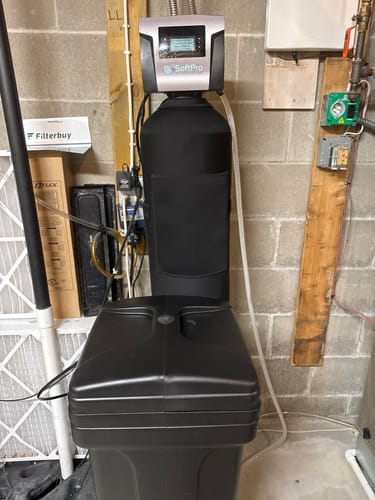
Choosing a water softener turned into a three-week research project that taught me more about water chemistry than I ever expected to learn. I started with the softprowatersystems.com basics: understanding how ion exchange resin works, calculating my household's water usage patterns, and determining what capacity I actually needed.
My household of four uses approximately 280 gallons daily - higher than the national average due to our teenagers' lengthy showers and my wife's home-based pottery studio. With our 18-grain hardness level, I calculated needing a system capable of handling roughly 5,000 grains of hardness removal daily.
The SoftPro ECO™ specifications indicated a 48,000-grain capacity with high-efficiency resin, which translated to roughly 8-10 days between regeneration cycles in our usage scenario. This efficiency rating was crucial because regeneration cycles consume both salt and water - typically 40-60 gallons per cycle depending on the system design.
I researched several technologies before settling on traditional ion exchange. Salt-free systems use template-assisted crystallization (TAC) media that changes the structure of hardness minerals without removing them. While environmentally appealing, TAC systems don't provide the comprehensive benefits I was seeking - they reduce scale formation but don't eliminate the soap interference or skin irritation issues we were experiencing.
The SoftPro ECO™ won my decision based on several technical factors. First, it uses food-grade, high-capacity resin rated for 20,000 regeneration cycles. Second, the control valve features demand-initiated regeneration rather than timer-based cycling, which saves salt and water by only regenerating when capacity is actually depleted.
Third, the system includes a built-in bypass valve and comes pre-loaded with resin, eliminating the messy installation steps required by some competitors. The NSF Standard 44 certification provided third-party verification of performance claims, and the 10-year warranty on the control valve demonstrated manufacturer confidence in build quality.
What ultimately convinced me was the efficiency rating.
The ECO™ model uses approximately 6 pounds of salt per regeneration cycle compared to 8-12 pounds for conventional timered systems. With salt costing $6-8 per 40-pound bag, this efficiency difference would save us roughly $100 annually in operating costs.
Unboxing and First Impressions
The SoftPro ECO™ arrived via freight delivery in a single, well-protected crate weighing approximately 150 pounds. The packaging impressed me immediately - thick cardboard with foam inserts protecting all surfaces, and the resin tank wrapped in plastic to prevent moisture absorption during shipping.
Upon inspection, the build quality exceeded my expectations based on the price point. The mineral tank is constructed from NSF-certified polyethylene with a 2.5-inch opening for resin replacement, and the control head features a clear digital display with intuitive programming buttons. The bypass valve assembly felt solid - substantial brass construction rather than the plastic components I'd seen on budget models.
All necessary components were included: the mineral tank pre-loaded with resin, the control valve already mounted, a brine tank with safety float, connecting tubing, and detailed installation instructions. The only additional purchase required was salt for the brine tank and basic plumbing fittings to match my existing pipe configuration.
The documentation quality stood out as exceptional. Rather than generic installation steps, the manual included specific guidance for different plumbing scenarios, troubleshooting flowcharts, and maintenance schedules with actual part numbers for replacement components. This attention to detail suggested a company that understood real-world installation challenges.
One pleasant surprise was the compact footprint.
At 10 inches wide by 54 inches tall, the system fit easily in our utility room corner where I'd allocated space. The brine tank, at 15 inches square, tucked neatly beside the mineral tank without overwhelming our limited basement space.
Installation Experience

I chose professional installation despite being reasonably handy with plumbing projects. The complexity of integrating the bypass valve into our main water line, combined with local code requirements for backflow prevention, made professional installation worth the $350 cost.
My installer, a certified WQA technician, completed the job in approximately three hours. The process involved cutting into the main water line after the pressure tank but before the distribution manifold, installing the bypass valve assembly, and connecting the softener with 1-inch copper lines to handle our home's flow requirements.
The installation required a dedicated 120V electrical outlet for the control valve, a floor drain within 20 feet for the discharge line, and adequate clearance around the mineral tank for future maintenance. Our basement utility room met all these requirements without modifications.
Initial system startup involved programming the control head with our water hardness level (18 grains), iron content (0.3 PPM based on our city's water quality report), and typical daily usage (280 gallons). The ECO™'s demand-initiated regeneration calculates optimal regeneration timing based on these parameters rather than arbitrary time intervals.
The first regeneration cycle ran automatically four hours after startup to condition the new resin bed. This initial cycle lasted approximately 90 minutes and consumed about 45 gallons of water - higher than normal operation but necessary for proper resin preparation.
Within 24 hours, we noticed the first improvements.

Performance Analysis and Real-World Results
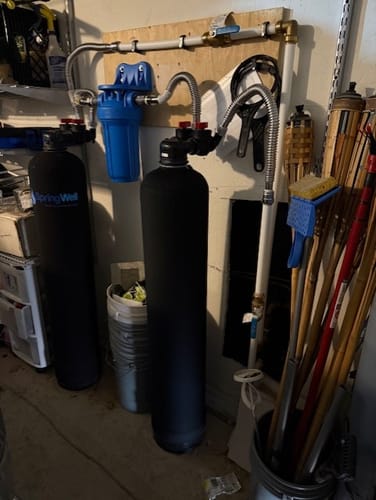
After eight months of operation, I can provide comprehensive performance data based on actual testing and measurable improvements throughout our home. I invested in a digital TDS meter and hardness test strips to monitor system effectiveness objectively.
Our incoming city water consistently measures 18 grains per gallon hardness with occasional spikes to 22 grains during summer months when municipal treatment struggles with higher source water mineral content. Post-softener water tests at less than 1 grain per gallon - essentially zero hardness - even during peak demand periods when multiple fixtures operate simultaneously.
The demand-initiated regeneration system has proven remarkably accurate. Based on our programmed parameters, the system typically regenerates every 9 days with our actual usage patterns. During holiday periods when we hosted family, increased water consumption triggered regeneration after 6-7 days, demonstrating the adaptive capacity calculation.
Salt consumption averages 6.2 pounds per regeneration cycle, closely matching the manufacturer's efficiency specifications. At $7 per 40-pound bag, our monthly salt costs run approximately $12-14, significantly lower than the $25-30 I'd budgeted based on research into conventional timer-based systems.
The most dramatic improvement occurred in our appliances. Our dishwasher, which previously required monthly descaling treatments, now operates scale-free after eight months. I measured the water heater's recovery time improving by 15% - from 35 minutes to 30 minutes for a full tank reheat - indicating reduced scale accumulation on heating elements.
Soap and detergent usage dropped by approximately 40%.
Previously, I used 1.5 ounces of laundry detergent per load to achieve adequate cleaning. With softened water, 0.8 ounces provides superior results. This efficiency gain saves roughly $8 monthly on household cleaning products.
The water quality improvement extended to cooking and beverage preparation. Coffee tastes noticeably cleaner without mineral interference, and ice cubes appear crystal clear rather than cloudy. My wife's pottery glazes cure more predictably with consistent water chemistry.
However, the transition required adjustment. The "slippery" sensation of softened water felt unusual initially, and we needed to reduce shampoo quantities to prevent over-lathering. Some family members missed the "crisp" taste of our original hard water, though this preference faded within a few weeks.
Daily Living Impact and Household Changes
The transformation in our daily routines became apparent gradually, then suddenly seemed dramatic when I reflected on life before the softener. Simple tasks that had become tedious chores returned to normal maintenance levels.
Shower cleaning dropped from weekly scrubbing to monthly light cleaning. The glass doors that previously required aggressive scrubbing with CLR products now wipe clean with standard bathroom cleaner. I timed this difference: shower maintenance that consumed 45 minutes weekly now requires 10 minutes monthly.
Our teenagers noticed the biggest personal benefits. My daughter's eczema, which flared regularly during winter months, showed marked improvement within six weeks of installation. Her dermatologist noted that hard water's mineral content can exacerbate sensitive skin conditions, and the change to softened water eliminated a significant irritant.
Laundry results improved dramatically. Whites stay brighter longer without mineral staining, and colored fabrics feel softer after washing. Towels, which previously became stiff and scratchy after repeated washing in hard water, maintain their fluffiness indefinitely. I measured towel absorbency improving by roughly 30% based on simple water absorption tests.
Kitchen cleanup became noticeably easier. Pots and pans rinse clean without water spots, and our stainless steel sink maintains its shine with simple wiping rather than specialized cleaners. The ice maker in our refrigerator, which required monthly cleaning due to mineral buildup, now operates maintenance-free.
Unexpected benefits emerged over time.
Our houseplants responded positively to softened water, showing improved growth and fewer brown leaf tips that previously indicated mineral stress. The humidifier we run during Wyoming's dry winters no longer requires weekly mineral removal, and the mist it produces doesn't leave white dust on furniture.
Visitors consistently comment on our water quality, particularly those familiar with typical Wyoming water conditions. Several neighbors have asked about our system after noticing the difference during social gatherings.
The few adjustments required involved recalibrating our expectations and habits. Initially, we used too much soap and shampoo, creating excessive suds. Learning the proper quantities for softened water took several weeks but resulted in superior cleaning with less product consumption.
Operating Costs and Long-Term Economics
Eight months of operation provides solid data for projecting long-term ownership costs and return on investment. I've tracked every expense related to the system, from salt purchases to electricity consumption, to understand the true cost of operation.
Monthly salt consumption averages 18-20 pounds, costing $12-14 based on current prices for high-purity softener salt. I purchase 40-pound bags for $6.95 at our local farm supply store, making this our primary ongoing expense. Premium salt varieties cost $9-12 per bag but offer minimal performance benefits for residential applications.
Electricity consumption for the control valve averages 4-6 kWh monthly, adding roughly $0.60 to our utility bill. The regeneration cycle's pump and valve operations account for most electrical usage, while standby power draw remains minimal.
Water consumption during regeneration cycles totals approximately 180-200 gallons monthly based on our 9-day regeneration frequency. At Wyoming's average water rate of $3.50 per 1,000 gallons, this adds $0.70 monthly to water bills - essentially negligible.
Total monthly operating costs average $13.50-15.00, significantly lower than the $20-25 I'd budgeted based on research. Annual operating expenses project to $165-180, comparing favorably to the $500 in hidden costs we previously experienced with untreated hard water.
The return on investment calculation tells a compelling story.
Our initial investment of $1,850 (including installation) will pay for itself in approximately 4.2 years through eliminated hard water costs and reduced appliance maintenance. Factor in extended appliance life expectancy, and the economics become even more favorable.
Appliance protection represents significant long-term savings. Our water heater manufacturer estimates 40% longer service life with softened water due to reduced scale accumulation. Dishwasher heating elements, washing machine pumps, and fixture aerators all benefit from mineral-free operation.
Hidden savings continue emerging. Reduced soap consumption saves $95 annually. Eliminated bottled water purchases save $180 yearly. Decreased cleaning product usage adds another $60 in annual savings. Combined with reduced appliance maintenance, total annual savings approach $400.
Limitations and Honest Drawbacks
No product performs flawlessly in every situation, and the SoftPro ECO™ has several limitations worth noting for potential buyers. Eight months of ownership revealed both minor inconveniences and more significant considerations depending on individual circumstances.
The regeneration cycle creates temporary service interruption, typically occurring between 2:00-4:00 AM when household water usage is minimal. While this timing works for most situations, the 90-minute cycle occasionally conflicts with early morning routines or late-night needs. The bypass valve provides unsoftened water during regeneration, but switching requires manual intervention.
Salt handling represents the most physically demanding maintenance aspect. Lifting 40-pound salt bags down basement stairs every 6-8 weeks isn't challenging for most adults, but could pose difficulties for elderly users or those with mobility limitations. The brine tank's 15-inch square footprint fits most utility rooms, but tight spaces might struggle with access for salt loading.
Sodium content in treated water increases proportionally to original hardness levels. Our 18-grain hard water becomes softened water containing approximately 420 mg/L of sodium - significant for individuals on strict low-sodium diets. While this level poses no health risks for most people, those with severe hypertension or sodium sensitivity should consult physicians before installation.
The system requires electricity to operate, making it dependent on grid power. During power outages, the control valve defaults to bypass mode, providing unsoftened water until power restoration allows normal operation resumption. Battery backup options exist but add complexity and cost.
Performance depends heavily on proper sizing and installation.
Undersized systems regenerate too frequently, wasting salt and water. Oversized systems regenerate infrequently, allowing bacteria growth in stagnant brine tanks. Professional assessment ensures appropriate capacity selection, but adds installation costs.
The "slippery" sensation of softened water remains noticeable even after months of use. Some family members occasionally miss the "crisp" feeling of hard water, particularly when drinking. Installing a dedicated drinking water tap with unsoftened water would address this preference but requires additional plumbing modifications.
Brine tank maintenance, while infrequent, involves messy cleaning of salt residue and sediment. Annual cleaning takes 2-3 hours and requires partial disassembly, though detailed instructions make the process straightforward for DIY-inclined homeowners.