
Hi, I'm SK O. I live in South Dakota. Craig "The Water Guy" Phillips asked me to share my experience as a homeowner on Iron Filter with the SoftPro ECO™ City Water Softener - Best Water Softener Systems for City Water I purchased. This is how my adventures played out. I hope this helps you in your decision.
Did you know that the average American household uses over 300 gallons of water daily, and if that water is hard, it's slowly damaging every appliance it touches?
I certainly didn't realize this until I started noticing white crusty buildup on my faucets, spotted glassware no matter how carefully I washed dishes, and my morning coffee tasting increasingly metallic. Living in South Dakota, I knew our water was hard, but I didn't understand the long-term costs until my water heater started making strange noises and my dishwasher began leaving softprowatersystems.com a filmy residue on everything.
After two years of owning and using the SoftPro ECO water softener daily, I can honestly say it's been one of those purchases that quietly improves your life in ways you don't fully appreciate until you've lived with it. The system is expensive, as I mentioned in my initial thoughts, but it's not as expensive as the name-brand alternatives I researched, and more importantly, it simply works great for us.
This isn't just another product review filled with technical specifications you can find anywhere. Instead, I'm sharing my real experience as a homeowner who researched extensively, invested in this system, and has lived with both its benefits and limitations for over two years. I'll walk you through my decision-making process, installation experience, daily usage patterns, maintenance realities, and the actual performance results I've measured in my own home.
The Hard Water Problem That Changed Everything
Before diving into my experience with the SoftPro ECO, let me paint a picture of what life was like in our South Dakota home with untreated city water. I'd always accepted that our water was "hard" - it's just part of living in this region - but I didn't truly understand what that meant until the problems started accumulating.
The first sign was subtle: my wife mentioned that her hair felt different after washing, almost sticky despite using quality shampoo. Then I noticed that our glassware, no matter how carefully I hand-washed it, always had spots and a cloudy film. The coffee maker started requiring monthly vinegar treatments to remove mineral buildup, and even then, my morning brew had an increasingly metallic taste that no amount of premium beans could mask.
But the real wake-up call came when our plumber pointed out the mineral deposits choking our water heater during a routine maintenance visit.
He explained that our hard water, measuring around 18 grains per gallon according to our city's water report, was essentially carrying dissolved calcium and magnesium that would precipitate out whenever the water was heated. These minerals were coating the heating elements, reducing efficiency and shortening the appliance's lifespan significantly.
The science behind hard water damage is straightforward but relentless. When water contains high concentrations of dissolved minerals - primarily calcium and magnesium carbonates - these minerals don't just disappear when you use the water. Instead, they leave behind scale deposits on every surface they contact, especially when heated. Over time, this scale buildup reduces water flow in pipes, decreases heating efficiency in appliances, and creates the perfect environment for bacterial growth.
I started calculating the hidden costs: increased soap and detergent usage (hard water prevents proper lathering), frequent appliance repairs, higher energy bills due to scale-covered heating elements, and the constant replacement of dishes and glassware that never looked clean. The financial impact was adding up to hundreds of dollars annually, not counting the frustration and time spent dealing with these issues.
My research phase began when I realized that living with hard water wasn't just an inconvenience - it was an expensive, ongoing problem that would only worsen over time. I needed a solution that would address the root cause, not just mask the symptoms with endless cleaning products and appliance repairs.
My Research Journey and Why I Chose SoftPro ECO
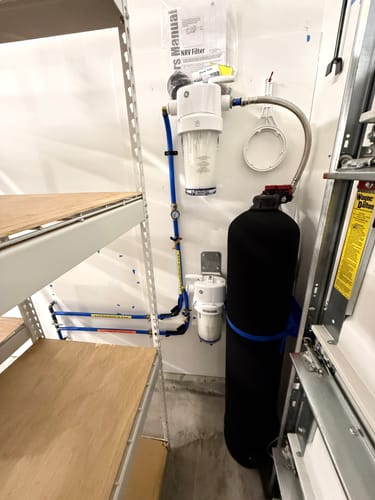
Once I committed to solving our hard water problem, I spent nearly three months researching different approaches. The water treatment industry is surprisingly complex, with multiple technologies claiming to solve the same basic problem. I wanted to understand not just what was available, but which solution would provide the best long-term value for our specific situation.
Initially, I explored salt-free water conditioners, attracted by the marketing promises of "maintenance-free" operation and environmental friendliness. However, after speaking with local water treatment professionals and reading independent studies, I learned that these systems don't actually remove hardness minerals - they claim to alter their structure to reduce scaling. For our 18-grain hardness level, multiple experts told me this approach would provide minimal improvement.
The consensus pointed toward traditional ion-exchange water softeners as the only technology that actually removes hardness minerals from water.
This process replaces calcium and magnesium ions with sodium ions, effectively eliminating the minerals that cause scaling and soap interference. While this meant ongoing salt costs and periodic maintenance, it also meant addressing the problem completely rather than just reducing its symptoms.
I evaluated several major brands, comparing capacity ratings, efficiency features, warranty terms, and total cost of ownership. The big-name brands like Culligan and Kinetico offered impressive systems but came with premium pricing that seemed to include substantial dealer markup. Their quotes for comparable capacity units were 40-60% higher than what I ultimately paid for the SoftPro ECO.
What attracted me to SoftPro specifically was their focus on efficiency and straightforward engineering. The ECO series uses a demand-initiated regeneration system that only backwashes when necessary, based on actual water usage rather than a preset timer. This means less salt consumption, less water waste during regeneration, and lower operating costs - all factors that matter when you're committed to long-term ownership.
The technical specifications aligned with our household needs: the 32,000-grain capacity matched our family size and hardness level, the 1-inch valve could handle our home's plumbing system, and the digital control head offered programming flexibility without unnecessary complexity. Most importantly, SoftPro's reputation for reliability and their comprehensive warranty gave me confidence in the long-term investment.
After requesting quotes and comparing total installed costs, the SoftPro ECO represented the best combination of proven technology, appropriate capacity, and reasonable pricing. It wasn't the cheapest option I found, but it offered the best value when I factored in warranty coverage, expected lifespan, and operating efficiency.
Unboxing and First Impressions
The SoftPro ECO arrived via freight delivery on a pallet, which immediately reinforced that this was serious equipment rather than a simple household appliance. The packaging was industrial-grade, with the main tank, control valve, and brine tank each secured separately to prevent shipping damage. Everything arrived in perfect condition, which spoke well of both the packaging design and the shipping handling.
My first impression when inspecting the components was the substantial build quality. The resin tank is constructed from high-strength fiberglass with a polyethylene liner, giving it a solid, permanent feel rather than the plasticky appearance of some competitors I'd seen. At roughly 150 pounds when filled with resin, this clearly wasn't designed as a portable or temporary solution.
The control valve assembly impressed me with its straightforward design and quality construction. The digital display was clear and intuitive, and the programming buttons felt substantial rather than cheap. I appreciated that SoftPro included clear labeling for all connections and a well-organized installation manual that explained not just the "how" but also the "why" behind each step.
The brine tank design was particularly thoughtful, with a salt platform that keeps the salt above the water level and a safety float that prevents overfilling.
These might seem like minor details, but they indicate attention to the practical realities of long-term operation and maintenance.
One pleasant surprise was the inclusion of a bypass valve assembly with the system. Some manufacturers charge extra for this essential component, but SoftPro includes it as standard equipment. The bypass valve allows you to temporarily divert water around the softener for maintenance or emergencies, which proved invaluable during my initial setup and testing phase.
The documentation package was comprehensive without being overwhelming. The installation guide used clear diagrams and step-by-step photos, while the programming manual explained the various settings and their practical implications. I particularly appreciated the troubleshooting section, which addressed common issues and their solutions - something I'd reference multiple times during my first year of ownership.
Installation Experience and Initial Setup

I decided to tackle the installation myself, partly to save on professional installation costs but mainly because I wanted to understand the system thoroughly. The SoftPro ECO is definitely a DIY-friendly system if you're comfortable with basic plumbing and have the necessary tools, though the physical weight of the components requires careful planning and possibly an extra pair of hands.
The pre-installation phase involved more preparation than I initially anticipated. Finding the right location required considering several factors: proximity to the main water line, access to electrical power, adequate drainage for the discharge line, and sufficient space for salt loading and maintenance access. My basement utility room provided the ideal setup, but I needed to install a new electrical outlet and run a drain line to my utility sink.
The actual plumbing connections were straightforward, thanks to SoftPro's clear documentation and quality fittings.
The system requires cutting into your main water line and installing the bypass valve assembly, which temporarily interrupts water service to your home. I scheduled this work for a weekend morning when we could manage without water for a few hours.
One challenge I encountered was achieving the proper support for the resin tank. At 150 pounds when operational, the tank needs a solid, level foundation. I ended up constructing a simple plywood platform to distribute the weight evenly across my basement floor joists. This extra step wasn't detailed in the manual but became obvious once I considered the long-term stability of the installation.
The initial system startup involves a careful sequence of filling, programming, and testing. The control valve needs to be programmed with your specific water hardness level, household size, and regeneration preferences. SoftPro's manual provides clear guidance for these calculations, but it requires some basic math to optimize the settings for your situation.
My first regeneration cycle was both exciting and slightly concerning - the system makes various mechanical noises during backwash and rinse phases that sound quite dramatic if you're not expecting them. These sounds are completely normal, but I recommend running your first regeneration when you're home to listen and ensure everything is operating correctly.
The initial water quality improvement was noticeable within hours of startup, but it took several days of operation before the system reached optimal performance. During this break-in period, I tested the water hardness daily using test strips to verify that the system was achieving the expected results.
Feature Analysis and Real-World Performance
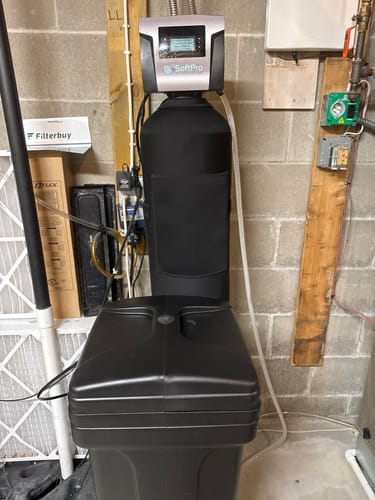
After two years of daily operation, I can provide detailed insights into how the SoftPro ECO's key features perform in real-world conditions. This isn't just about manufacturer specifications - it's about how these features translate into practical benefits and occasional limitations in actual household use.
The demand-initiated regeneration system has proven to be one of the most valuable features for controlling operating costs.
Rather than regenerating on a fixed schedule regardless of water usage, the system monitors actual consumption and only initiates backwash cycles when the resin bed approaches saturation. For our household of four, this typically means regeneration every 8-10 days during normal usage periods, but extends to 12-14 days during vacations or low-usage periods.
This efficiency translates into measurable salt savings compared to timer-based systems. I track salt usage carefully and average about 2.5 bags of salt per month, significantly less than the 4-5 bags I'd calculated for a timer-based system of similar capacity. At current salt prices, this saves approximately $40-50 annually while also reducing the environmental impact of regeneration waste.
The 32,000-grain capacity handles our household demands comfortably, even during high-usage periods like holidays when we're running multiple appliances simultaneously. I've never experienced a situation where the system couldn't keep up with demand, and the softened water quality remains consistent throughout the regeneration cycle.
However, the system's flow rate can become a limiting factor during extreme peak demand situations. While the 1-inch valve is rated for adequate flow for most homes, I've noticed slight pressure reduction when running the dishwasher, washing machine, and multiple showers simultaneously. This isn't a daily issue, but it's worth considering if your household frequently has high simultaneous water usage.
The digital control interface has been reliable and user-friendly, though it's more utilitarian than elegant.
The display clearly shows days until regeneration, current settings, and system status. Programming adjustments are straightforward once you understand the button sequence, though I reference the manual occasionally for less common settings.
One feature I've grown to appreciate is the manual regeneration option. During periods when we have house guests or unusual water usage, I can initiate an immediate regeneration cycle to ensure optimal water quality. The system completes this cycle overnight, typically finishing within 2-3 hours without disrupting household activities.
The bypass valve has proven essential for maintenance and testing. I can easily isolate the softener for resin bed inspection, system cleaning, or emergency repairs without shutting off water to the entire house. This feature also allows me to provide unsoftened water for specific applications like garden watering or car washing when desired.
Build quality has exceeded my expectations over two years of operation. The resin tank shows no signs of wear or deterioration, the control valve operates smoothly without mechanical issues, and all plumbing connections remain secure without leaks or corrosion. The system feels built for long-term reliability rather than planned obsolescence.
Daily Life Impact and Household Benefits
The most significant impact of the SoftPro ECO isn't measured in technical specifications - it's experienced in the countless small improvements to daily household activities. After two years, these benefits have become so integrated into our routine that I only notice them when we travel and encounter hard water elsewhere.
The transformation in our morning routines was immediate and dramatic.

Similarly, my skin stopped feeling tight and itchy after showers, a problem I'd attributed to winter weather but now realize was caused by hard water minerals interfering with soap effectiveness. The softened water allows soap to lather properly and rinse completely, eliminating the residue that was irritating our skin.
Kitchen activities have become markedly more pleasant and efficient. Glassware emerges from the dishwasher spotless without pre-rinsing or special detergents, and hand-washed dishes dry naturally without water spots. The coffee maker hasn't required descaling in over 18 months, and the improvement in coffee taste was noticeable enough that guests comment on it.
Our appliances are clearly benefiting from the mineral-free water. The washing machine no longer leaves white residue on dark clothing, and fabrics feel noticeably softer without fabric softener. Whites stay bright longer, and colors appear more vibrant because hard water minerals aren't dulling the fabric fibers.
The water heater efficiency improvement became apparent on our first winter heating bill after installation.
Without mineral scale coating the heating elements, the unit reaches temperature faster and maintains it more efficiently. Our plumber confirmed during a recent service call that the heating elements show no mineral buildup - a dramatic change from their previous condition.
Cleaning throughout the house requires significantly less effort and fewer harsh chemicals. Bathroom fixtures no longer develop the crusty white buildup that required weekly scrubbing, and shower doors stay clearer with simple weekly cleaning. The time savings alone justify the softener investment, not counting the reduced expense of cleaning products.
However, there are minor adjustments required with softened water. Soap and shampoo usage needs to be reduced because they're much more effective in soft water - using normal amounts initially left us feeling over-sudsy. Garden watering requires using the bypass valve because many plants prefer unsoftened water, though this is easily managed with proper planning.
The overall impact extends beyond immediate convenience to long-term household value. Our appliances will last longer, our plumbing system will remain clearer, and we're avoiding the gradual damage that hard water causes to fixtures and finishes throughout the home.
Operating Costs and Long-Term Value Analysis
Understanding the true cost of water softener ownership requires tracking both obvious expenses like salt purchases and subtle savings from improved appliance efficiency and reduced maintenance. After two years of careful record-keeping, I can provide realistic operating cost projections based on actual usage rather than manufacturer estimates.
Salt consumption averages 2.5 bags monthly at approximately $6 per bag, resulting in $180 annual salt costs.
This is considerably lower than my initial projections of $240-300 annually, thanks to the demand-initiated regeneration system's efficiency. During low-usage months, particularly summer periods when we travel frequently, salt consumption drops to 1.5-2 bags monthly.
I use Morton System Saver salt pellets, which cost slightly more than basic rock salt but provide cleaner operation and reduced maintenance requirements. The few extra dollars per bag are justified by the reduced cleaning and service needs, making the total cost of ownership lower despite the premium salt price.
Electrical consumption is minimal, adding approximately $3-4 monthly to our utility bills based on our local electricity rates. The control valve draws power only during regeneration cycles and for maintaining the digital display, making it comparable to a small household appliance in terms of energy usage.
Water usage during regeneration averages 45-50 gallons per cycle, occurring every 8-10 days under normal conditions. This adds roughly 150-200 gallons monthly to our water bill, or about $8-10 in additional costs. While this isn't negligible, it's significantly less than the 300 gallons monthly that timer-based systems typically consume.
The cost savings from appliance protection and cleaning reduction are harder to quantify precisely but clearly substantial.
Our water heater hasn't required descaling since installation, saving the $150 annual service costs we previously incurred. The dishwasher operates more efficiently without mineral buildup, and we've eliminated the monthly vinegar treatments that all our small appliances previously required.
Soap and detergent usage has decreased dramatically across all applications. Laundry detergent lasts nearly twice as long because soft water allows it to work more effectively at lower concentrations. Dish soap, shampoo, and hand soap usage have all decreased by 30-40% while providing superior results.
When I calculate the total annual operating cost - salt, electricity, water, and maintenance supplies - the system costs approximately $275 yearly to operate. Against this, I'm saving an estimated $200 annually in appliance maintenance, cleaning products, and soap consumption, plus immeasurable benefits in time savings and improved household comfort.
The return on investment timeline depends on your specific water conditions and household usage patterns, but for our situation, the system will pay for itself through direct cost savings within 8-10 years. When I factor in appliance longevity, reduced maintenance stress, and quality-of-life improvements, the value proposition becomes compelling much sooner.
Limitations and Honest Drawbacks
No product is perfect, and the SoftPro ECO has several limitations and minor frustrations that potential buyers should understand before making a purchase decision. After two years of ownership, I can identify the areas where the system falls short of ideal and situations where alternative solutions might be more appropriate.
The most significant limitation is the space requirement for proper installation and maintenance access.
The system needs considerable floor space for the resin tank, brine tank, and adequate clearance for salt loading. In cramped utility rooms or homes without basement space, finding an appropriate location can be challenging. The brine tank, in particular, requires top access for salt loading, which means ceiling height considerations in some installations.
Salt handling remains a physical chore that some households may find burdensome. Loading 40-pound salt bags monthly requires lifting and pouring, which can be difficult for older homeowners or those with physical limitations. While salt delivery services are available in some areas, they add to the operating costs and may not be convenient for rural locations.
The regeneration process, while efficient, does create temporary disruption to water service quality. During the backwash and rinse cycles, water pressure throughout the house is reduced, and the water may have a salty taste for 10-15 minutes after regeneration completes. This rarely affects daily routines since regeneration typically occurs overnight, but it's noticeable if you happen to use water during the process.
The system produces wastewater during regeneration that may be problematic for septic systems or environmentally sensitive areas.
Each regeneration cycle discharges approximately 50 gallons of saltwater that must be properly disposed of through your home's drainage system. For households on septic systems, this can potentially disrupt bacterial balance, though modern septic systems typically handle this load without issues.
Programming complexity, while manageable, requires some technical understanding to optimize performance. The default settings work adequately, but achieving maximum efficiency requires calculating proper hardness compensation, understanding regeneration timing options, and adjusting for seasonal usage variations. This isn't necessarily a flaw, but it's more involved than simply plugging in an appliance.
The digital display, while functional, feels somewhat dated compared to modern smart home devices. There's no remote monitoring capability, smartphone integration, or detailed usage analytics. For a system at this price point, more advanced connectivity options would enhance the user experience and provide better insight into performance trends.
Maintenance access could be improved with better design consideration for component serviceability. While routine tasks like salt loading and basic cleaning are straightforward, accessing internal components for repairs or deep cleaning requires more disassembly than ideal. This generally isn't an issue for normal operation, but it complicates professional servicing when needed.
Finally, the initial investment cost remains substantial for many households. While the long-term value proposition is sound, the upfront expense of $1,200-1,500 (including installation materials) represents a significant budget commitment that not all families can easily accommodate, even when the benefits justify the cost.